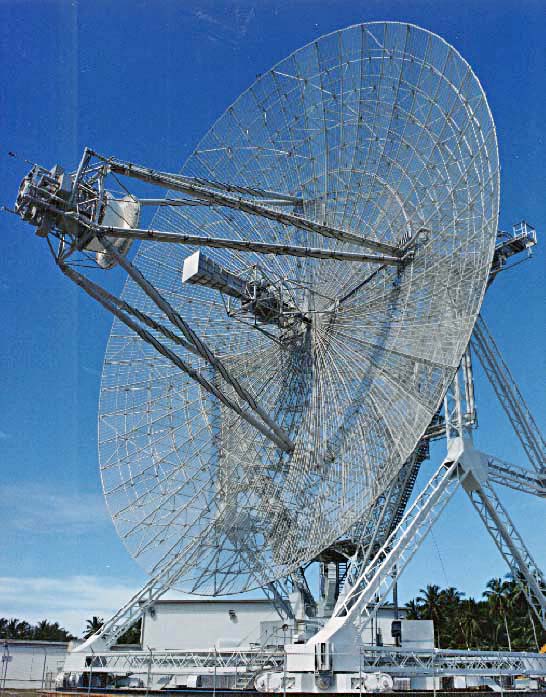
Deep Space Network
NASA's Deep Space Network is the world's largest and most sensitive scientific telecommunications system - a worldwide array of radio antennas that talk to spacecraft across the solar system and beyond. Three complexes in California, Spain, and Australia provide continuous coverage as Earth rotates.
NASA's Deep Space Network provides continuous communication with spacecraft across the solar system.
Global Coverage
The Deep Space Network consists of three complexes positioned approximately 120 degrees apart around the Earth - ensuring that as our planet rotates, at least one complex can always communicate with any spacecraft:
- Goldstone, California: Located at 35°25'N 116°53'W in the Mojave Desert, this complex handles missions in the deep southern sky and serves as the primary complex for missions heading away from Earth.
- Canberra, Australia: Located at 35°13'S 148°59'E in the Australian Capital Territory, this complex covers the southern sky and was critical for Apollo Moon missions. It is the only complex that can communicate with spacecraft near the galactic center.
- Madrid, Spain: Located at 40°26'N 4°15'W near Robledo de Chavela, this complex covers the mid-range solar system and provides redundancy for transpacific and transatlantic links.
The 120-degree separation ensures continuous coverage. As one complex rotates out of view of a spacecraft, the next complex on Earth's opposite side picks up the signal within minutes.
70m Antenna Specifications
The 70-meter antennas are the largest and most sensitive elements of the DSN, capable of receiving incredibly faint signals from spacecraft billions of kilometers away:
- Diameter: 70 meters (230 feet) - the largest steerable radio antenna in the world
- S-band Gain: 62.95 dBi at 2.3 GHz
- X-band Gain: 73.23 dBi at 8.4 GHz
- Noise Temperature (S-band): 12.22 K - approaching the quantum limit
- Noise Temperature (X-band): 11.65 K
- Transmit Power: 20 kW (20,000 watts) at S-band
- Pointing Accuracy: 0.002 degrees (7 arcseconds)
- Weight: approximately 2,700 metric tons
Only three 70m antennas remain operational: DSS-14 at Goldstone, DSS-43 at Canberra, and DSS-63 at Madrid. The Canberra DSS-43 was upgraded in 2020-2022 to support the Deep Space Optical Communication experiment.
34m Beam Waveguide Antennas
The 34-meter Beam Waveguide (BWG) antennas are the workhorses of the DSN, providing reliable daily communication with dozens of spacecraft:
- Diameter: 34 meters (112 feet)
- S-band Gain: 56.1 dBi
- X-band Gain: 67.1 dBi
- Design: Beam waveguide optics route the signal through a tower to a pedestal room below ground, housing receivers and transmitters at ground level for easier maintenance
- Frequency Support: S-band, X-band, and Ka-band (26-40 GHz)
- Count: Two to three BWG antennas per complex, with additional future builds planned
The BWG design uses a series of mirrors to focus radio waves into a below-grade equipment room, eliminating the need to lift heavy electronics 100 meters into the air. This makes maintenance dramatically easier and cheaper than the older 64m or 70m designs.
Antenna Feed System
DSN antennas use a dichroic reflector to separate S-band and X-band signals simultaneously, allowing two-way communication on different frequencies at the same time. The reflector transmits S-band while reflecting X-band to a separate feed horn. This dual-band capability is essential for missions that use S-band for telemetry and X-band for science data downlink.
Modern DSN antennas also support Ka-band (26.5-40 GHz) for high-rate data return from missions like Mars Reconnaissance Orbiter, which achieves up to 6 Mbps using Ka-band from Mars.
20kW S-Band Transmitter
Each DSN complex houses powerful transmitters capable of sending commands to spacecraft across the solar system. The S-band transmitter operates at 2.1 GHz with 20,000 watts of output power, focused into a narrow beam by the antenna. This is enough power to reach Voyager 1 at 24+ billion kilometers.
For future missions, the DSN has 400 kW of available transmitter power capacity, though this is not currently utilized for Voyager, which requires only a fraction of a watt at Earth. The excess capacity is reserved for future missions requiring higher data rates to extreme distances.
Signal Challenges
At the distance of Voyager 1 (24+ billion km), the signal received by DSN is incredibly weak - about 10⁻¹⁶ watts, or a billionth of a billionth of a watt. To put this in perspective, it's like detecting a single photon from a laser pointer from thousands of miles away. Voyager's 23-watt transmitter produces a signal that, by the time it reaches Earth, is weaker than the thermal noise of a single hydrogen atom. The DSN uses ultra-low-noise maser amplifiers cooled to 4 Kelvin (-269°C) to detect these signals.
Communication Frequencies
- S-band (2-4 GHz): Primary uplink frequency for commands, also used by older missions for telemetry downlink
- X-band (8-12 GHz): Primary deep space downlink for science data, offering 10x better gain than S-band
- Ka-band (26-40 GHz): High data rate missions, modern upgrades - enables Mbps data rates from Mars
Data Processing
Raw DSN data flows from the antenna complexes to JPL's Mission Control via dedicated fiber optic links and the NASA Integrated Services Network (NISN). At JPL, the Signal Processing Center decodes telemetry, ranging, and Doppler data. The DSN processes data for over 30 missions simultaneously, with each complex handling a subset on a scheduled basis.
Notable Missions Supported
- Apollo Moon landings
- Voyager 1 & 2 (interstellar)
- Mars rovers (Spirit, Opportunity, Curiosity, Perseverance)
- Cassini-Huygens (Saturn)
- New Horizons (Pluto)
- James Webb Space Telescope
International Partners
The DSN works with other space agencies' tracking networks including ESA's ESTRACK, Russia's Deep Space Network, Japan's JAXA, India's ISRO, and China's CNSA. This international cooperation ensures continuous coverage for interplanetary missions. NASA and ESA share DSN/ESTRACK resources through a bilateral agreement, with ESA providing ground stations at New Norcia (Australia), Cebreros (Spain), and Malargüe (Argentina).
Illustrations